I.
"Europe will be forged in crises, and will be the sum of the solutions adopted for those crises."
(Jean Monnet).
The European Union is currently under threat – from the outside by Russia's war of aggression; from
within by demagogues, racists, anti-Semites and anti-Europeans.
The European model of freedom, peace, democracy and prosperity is in jeopardy.
At the same time, European economy and technology are in urgent need of a boost in innovation. In
addition, the transatlantic partnership for security and defence, trade and stability must be
strengthened. This calls for a strong, unified Union.
The world order is changing, and Europe needs to respond.
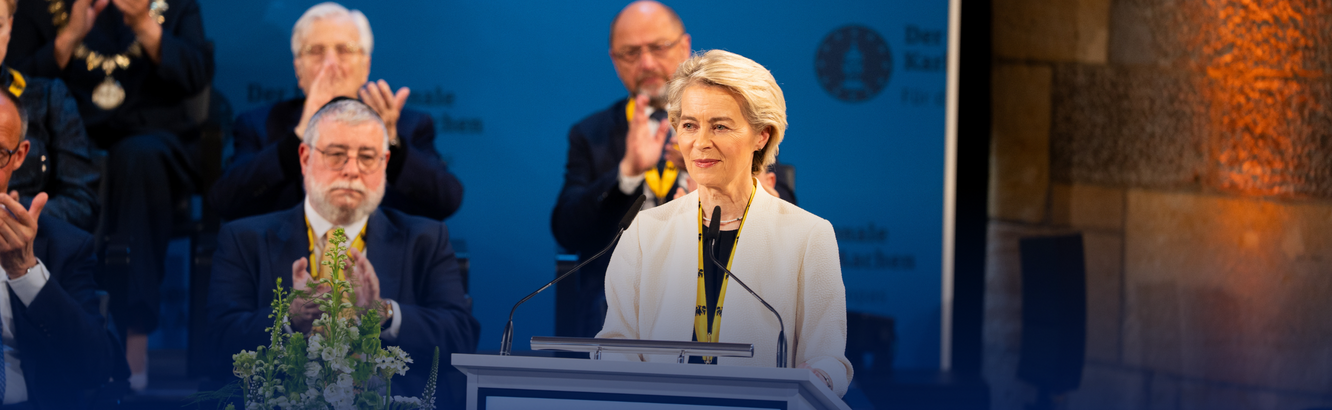
Ursula von der Leyen is the person whose role it is to face – and fulfil – this strategic challenge for the
European Union.
She personifies Europe. She is the powerful voice of Europe on the world’s stage. She is the one with
the strength to represent the interests of Europe and its allies in these historic times. And – due to the
recognition she has acquired in office – she is equipped with the skills needed to master existing and
future challenges.
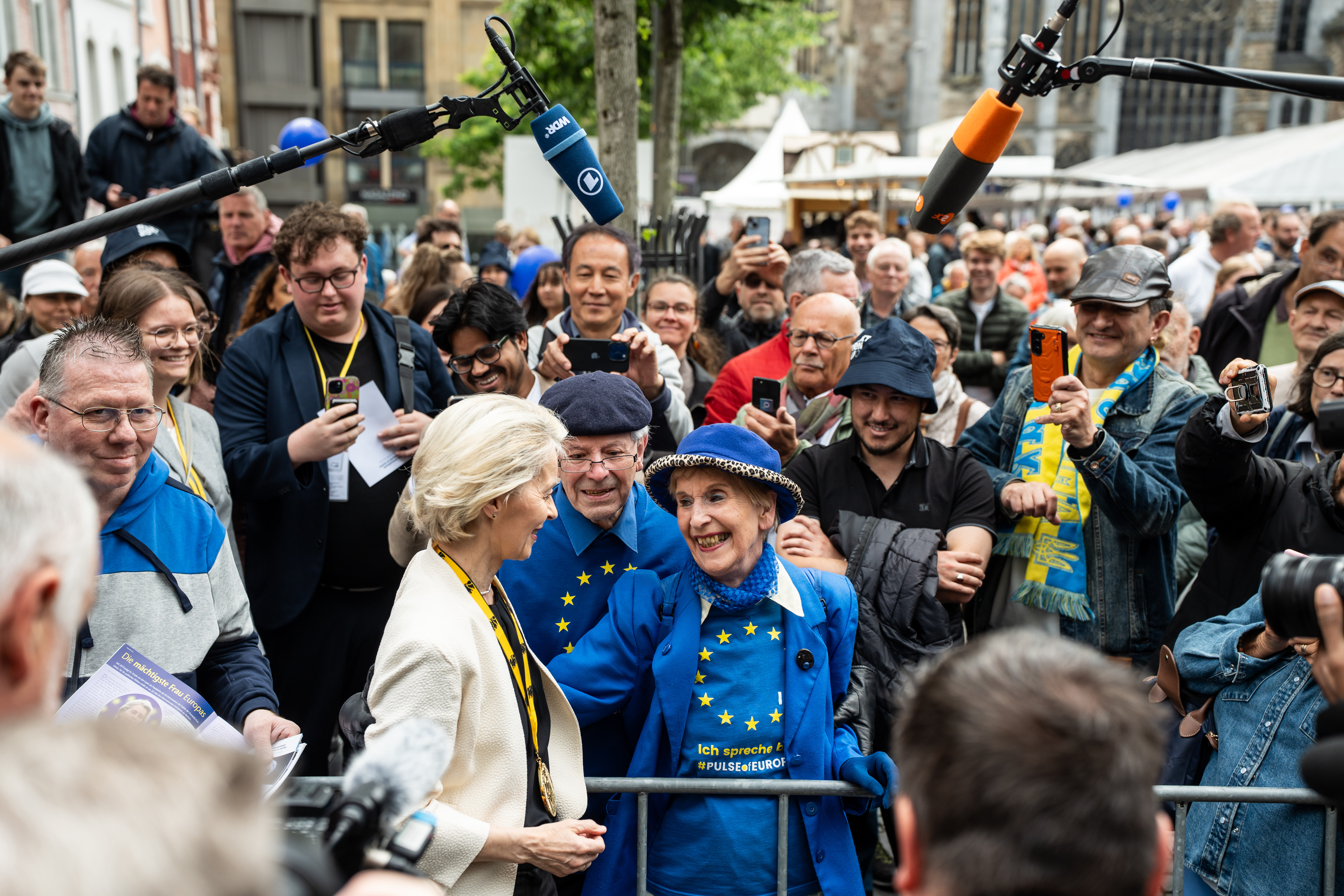
In recognition of her services to the unity of the Member States, in the containment of the pandemic,
for the unity of the Union's determination to defend itself against Russia – and for the impetus towards
the Green Deal, on the one hand, and, on the other, to encourage her in the face of the challenges that
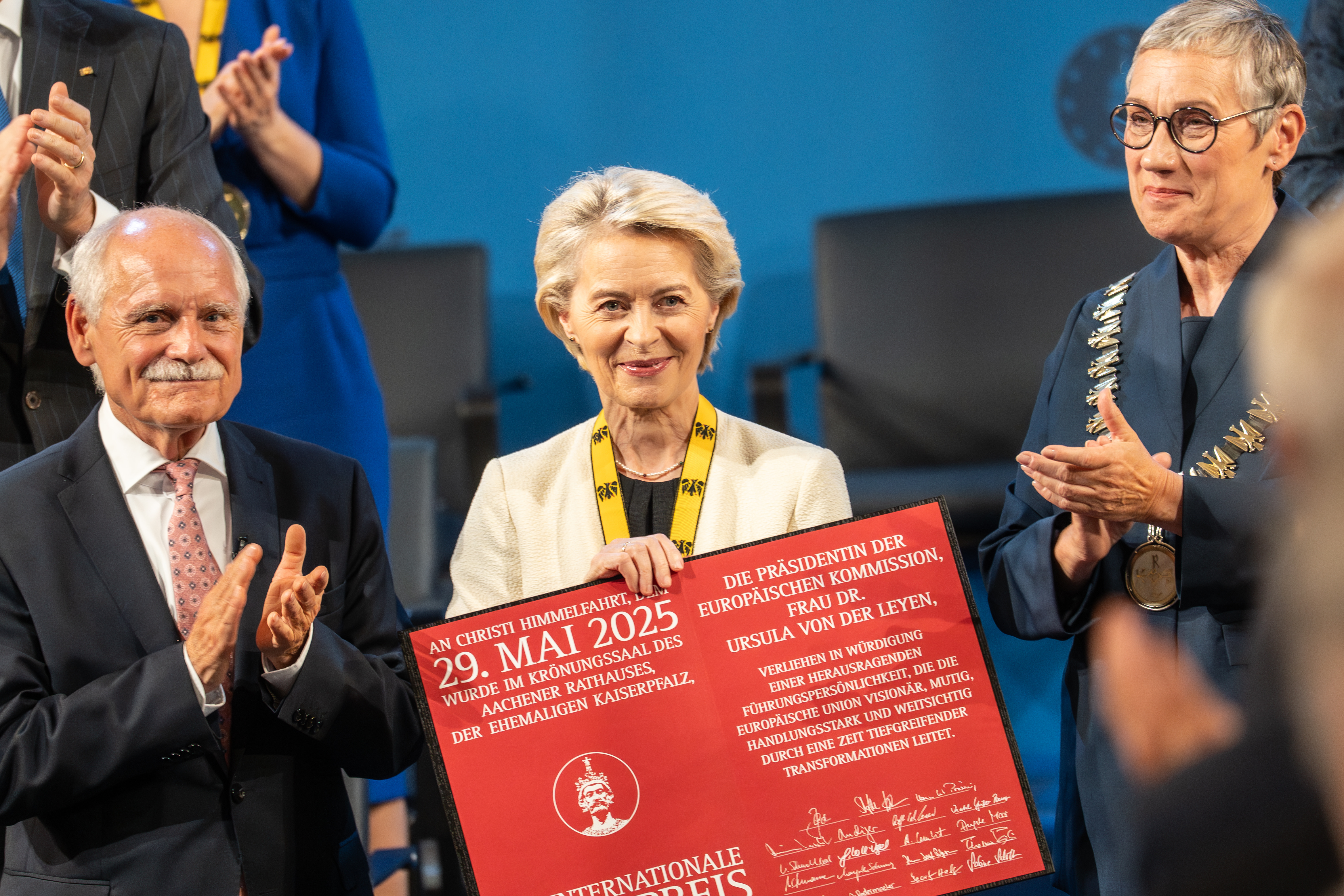
lie ahead, the Board of Directors of the Society for the Conferring of the International Charlemagne
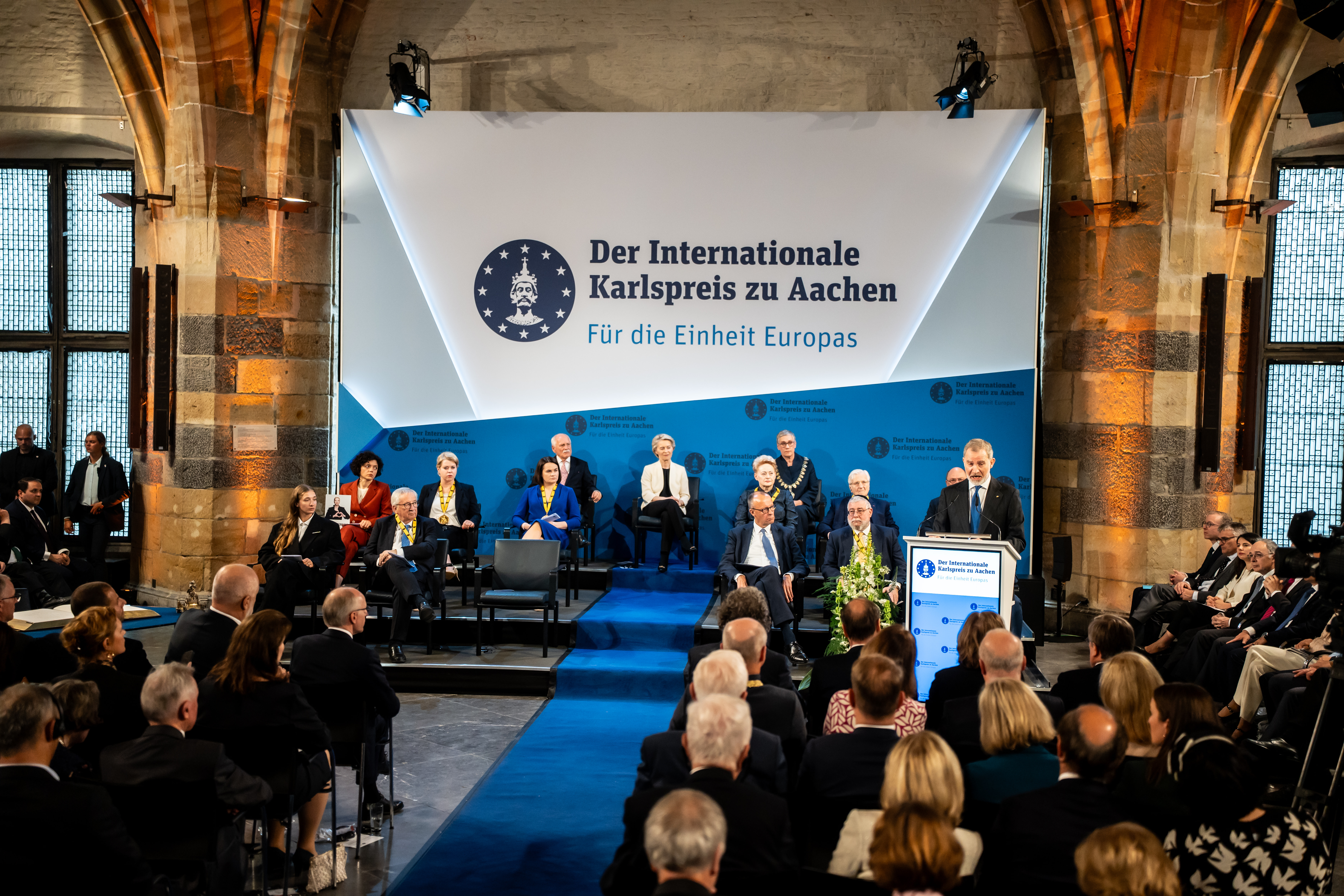
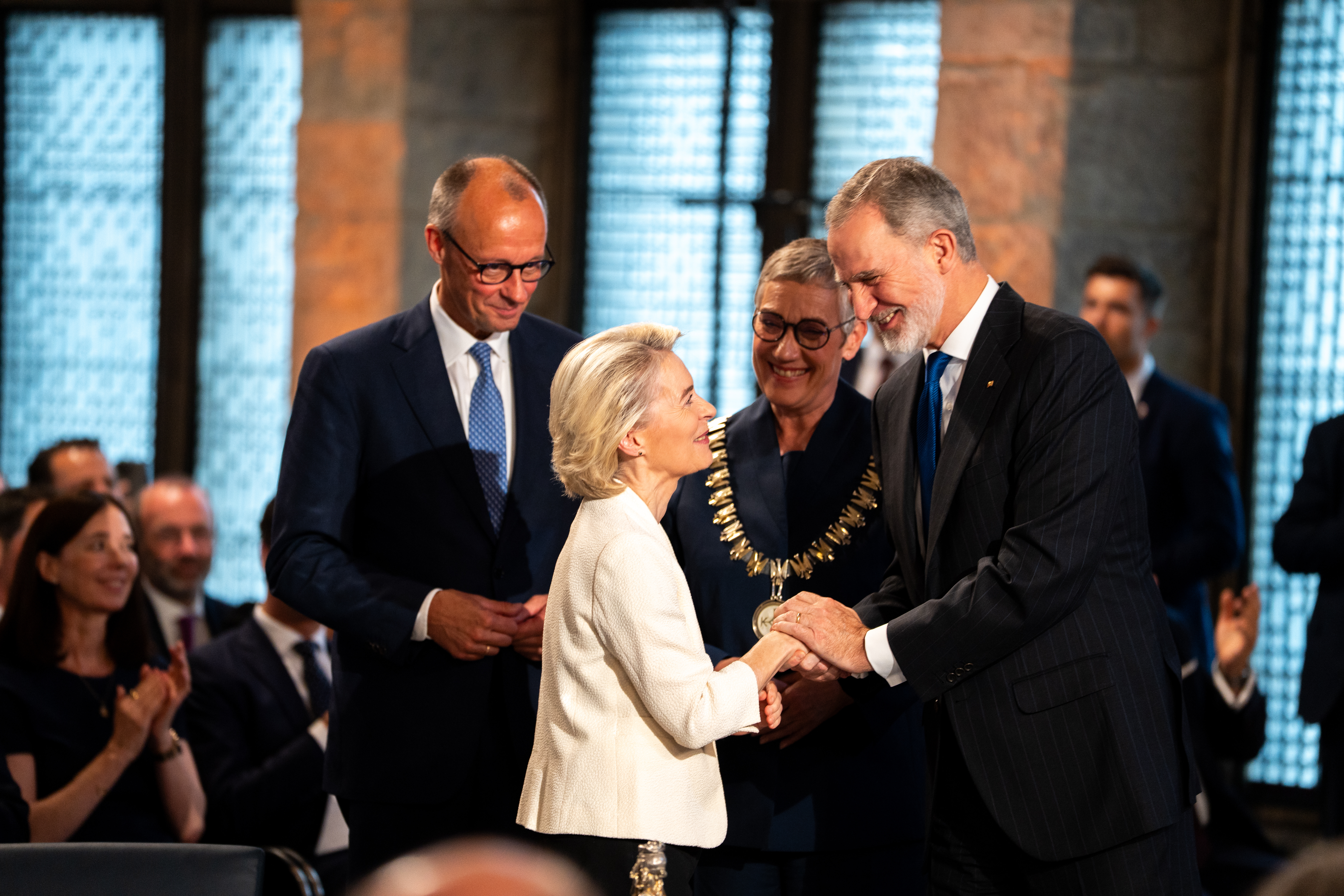
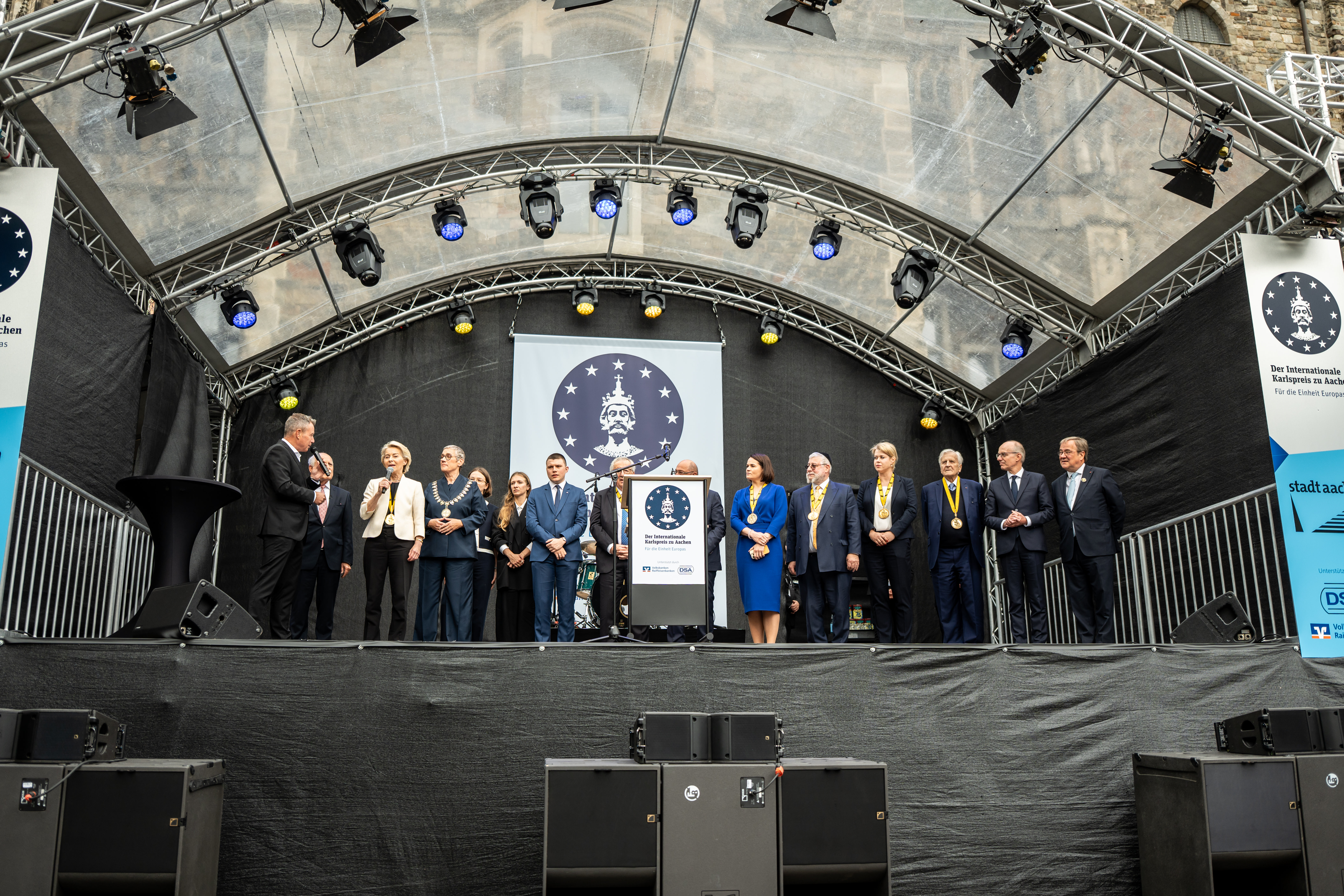
Prize of Aachen have elected, with its 2025 award, to honour the President of the European
Commission, Dr. Ursula von der Leyen.
II.
Ursula von der Leyen was born on 8 October, 1958, in Ixelles, a municipality of the Brussels-Capital
Region. At that time, her father, Ernst Albrecht – who would later become Minister President of the
State of Lower Saxony – was working as the Chef de Cabinet to Hans von der Groeben, the European
Commissioner for Competition. Albrecht later advanced to the post of Director-General of the
Directorate-General for Competition. When he was elected to the Lower Saxon Landtag, he moved
with his family at the beginning of the 1970s to Ilten near Hannover.
After matriculating from secondary school, the 18-year-old Ursula von der Leyen began her studies of
Archeology and Economics, before ultimately deciding, in 1980, to switch to Medicine. In 1987 – in the
meantime married to the graduated Doctor of Medicine, Heiko von der Leyen – she passed her state
exams and, shortly after, acquired her licence to practise medicine, from then on working as an
Assistant Physician at the Hannover Medical School (MHH). In 1991, she graduated as a Doctor of
Medicine. From 1992 to 1996, she lived with her family in California, where she continued her studies
as a guest student at Stanford University. In 2001, she completed further post-graduate studies at the
University of Hannover, earning the title "Master of Public Health" and continuing to work at the MHH.
Already having been an active member of the CDU since 1990, around the turn of the century Ursula
von der Leyen made her 'lateral entry' into politics. In 2003, she secured a mandate in the Lower Saxon
Landtag and was appointed by Minister President Christian Wulff to serve as Minister for Social Affairs,
Women, Family, and Health in his first Cabinet. In 2005, as the Federal Minister of Family Affairs, Senior
Citizens, Women and Youth, she made her transition to federal politics. In 2009, she assumed the post
of Federal Minister of Labour and Social Affairs. Finally, in 2013, she became the first woman to be
appointed Federal Minister of Defence, an office in which she would be confirmed four years later.
III.
On 2 July, 2019, Ursula von der Leyen was nominated for the office of President of the European
Commission. And she succeeded in gaining a parliamentary majority for an extremely demanding and
ambitious programme.
The objectives she announced for the work to be done in the coming five years were bold and
ambitious, and featured six priorities:--
"An economy that works for people" to ensure social justice and prosperity;
"The European Green Deal", the development of a new growth model based on a clean
circular economy – with the goal of becoming climate neutral by 2050;
"A Europe fit for the digital age" to ensure that society benefits from new technologies, and
becomes even more competitive through innovation;
"A stronger Europe in the world" that assumes greater responsibility and stands for
multilateralism and a rules-based order;
"Promoting the European way of life", which is characterised by common values and the
enforcement of the rule of law; and, associated with this,
"A new push for European democracy".
However, it would soon become clear that the EU was confronted with challenges on a previously
unimagined scale.
IV.
On 31 December, 2019, shortly after confirmation of the outbreak of a new respiratory disease in
Wuhan, China, the WHO declared a global pandemic which, within a few months, would claim the lives
of more than one million people.
The European Commission shouldered the responsibility for a coordinated European vaccination
strategy and played a key role in securing funding for the development of effective vaccines, ensuring
within a few months that not only did Europeans have access to several billion doses of Covid-19
vaccines, but developing countries were also supplied with them.
When vaccination allowed the massive restrictions on free movement to be eased, the digital EU Covid
certificate ensured that safer travelling was made easier.
With a loan programme of almost 100 billion euro to finance short-time work and furlough schemes,
the EU has supported over 30 million employees and self-employed workers and more than 2.5 million
companies since 2020. Moreover, with the help of the NextGenerationEU recovery fund, the European
Commission ensured that the economy not only overcame the immediate consequences of the
pandemic, but was also strengthened in the long term.
V.
When Russia launched its brutal war of aggression against Ukraine in February 2022, the dictator in the
Kremlin was also relying on the disunity of the Europeans. But to no avail. On the contrary, Ursula von
der Leyen was able to state, in her State of the Union Address in September 2022, that from the very
first moment "a whole continent has risen in solidarity", that "our Union as a whole has risen to the
occasion ... [and] our response was united, determined and immediate." – with the acceptance of more
than four million refugees from Ukraine and the mobilisation of more than 130 billion euros for
humanitarian, economic and military aid, among other things. At the same time, the European
Commission put together more than a dozen sanctions packages against the Russian aggressor and
ensured that the Russian Central Bank's funds – totalling over 210 billion euros – were frozen in the EU
alone.
Together with allies around the world, the EU provided collective, solidarity-based military support to
Ukraine in its defensive war. Ukraine soon gained official EU candidate status, and, in the following
year, the decision to begin accession negotiations was taken.
When the Kremlin's attempt to blackmail the EU over energy supplies became apparent, right at the
start of the war of aggression, the Commission, in spring 2022, presented the REPowerEU plan, which
was used to significantly reduce dependence on imports of coal, oil and gas from Russia. In addition to
energy savings and the accelerated expansion of renewable energies, it was, above all, the coordinated
diversification of supply and supply routes and the establishment of an EU energy platform – through
which the Union bundled its demand for natural gas and thus strengthened the negotiating position of
European companies on the global markets – that made it possible to overcome the greatest energy
crisis in decades.
VI.
The European Commission under the leadership of Ursula von der Leyen have played a decisive role in
ensuring that the EU has been able to face crises of historic proportions with unity and success.
At the same time, following global trends, extreme nationalist ideas have grown, as have rejection of
the globalised world and multiculturalism, anti-democratic tendencies and anti-Semitism, as well as
demagogy and hatred against all established structures and political institutions.
In the elections in June 2024, anti-Europeans made significant gains, but the democratic parties were
able to maintain their majority. As Ursula von der Leyen defiantly declared: "The centre is holding!"
and, soon after, she was re-nominated as Commission President by the European Council. She
succeeded in uniting large parts of the pro-European centre of the Parliament – Christian and Social
Democrats, Liberals and Greens – behind her, thus creating a clear, comfortable pro-European
majority.
Thanks to Ursula von der Leyen and her skilful diplomacy, Europe has managed to push the opponents,
doubters and sceptics into the minority.
Competitiveness, defense, strategic cohesion and reductions in bureaucracy are core demands of her
new programme for her current term of office.
With her "Clean Industrial Deal", she wants to make European industry more competitive again, make
the rules more industry-friendly and compliant with climate policy targets. An important part of her
industrial policy is the fight for the survival of the European automotive industry.
Detailed regulations, such as the EU supply chain law, sustainability reporting and the EU taxonomy,
which have been criticised by the industry, are to be made more flexible for industry and companies.
All in all, she sees a need for a Commission of Investments and a clear focus on competitiveness. She
commissioned the former ECB President, Mario Draghi, with the drafting of key recommendations for
action, and, in September 2024, he presented his "Report on the Future of European Competitiveness"
– a comprehensive analysis of the challenges and opportunities, as well as strategic approaches to the
promotion of growth and stability, that now need to be implemented. In terms of trade policy, a first
step was taken with the conclusion of the EU-Mercosur negotiations and the EU-Switzerland
agreement.
Ursula von der Leyen knows that Europe's economic security requires transatlantic cohesion. In this
respect, following changes to the political structures in the United States, a special strategic effort on
the part of Europeans is now called for. The most important prerequisite for success in these
endeavours is unity among Member States. Like no other, Ursula von der Leyen is fighting for this unity
and endeavouring to unite the many political currents within the EU Member States in terms of
content, and thus to strengthen Europe's significance in the arena of global political events.
In the shaping of the partnership, she will negotiate on equal terms and vigorously pursue European
interests.
Ursula von der Leyen has reorganised Europe's democratic centre so that the EU is capable of action
and can best represent the concerns of European citizens, even in global political issues.
VII.
With this award to the President of the European Commission, Dr. Ursula von der Leyen, the Board of
Directors of the Society for the Conferring of the International Charlemagne Prize of Aachen in 2025 –
its 75th anniversary – honours an outstanding personality of a united Europe, one whose visionary,
courageous and dynamic leadership will guide the Union, with decisiveness and perspicacity, through
these times of profound transformations.
At the same time, the Charlemagne Prize Board of Directors also wish to encourage and strengthen the
President in her determination to represent the EU as a significant force in the arena of global politics,
to lead it as a power founded in pro-peace, pro-democracy and pro-partnership ideals, to strengthen
Europe as a society of values and, through more competitiveness, to ensure that this great European
Peace Project can also keep its promise to its citizens of economic and social well-being